The Wisdom of the Bees
A central idea of this blog is that ‘polis’ and ‘psyche’ (city-state and soul) are two manifestations of the same archetype. ‘Polis’ is a macrocosm and ‘psyche’ is a microcosm, but they are fundamentally similar, having the same ‘axial structure’. In my post the ‘Characteristics of Politics’ I referenced Aristotle’s famous quote that “man is a political animal” and affirmed his distinction between political and social, which contrasts man as political animal with bees who are merely social according to the Hakim (Arabic epithet for Aristotle meaning ‘wise one’).
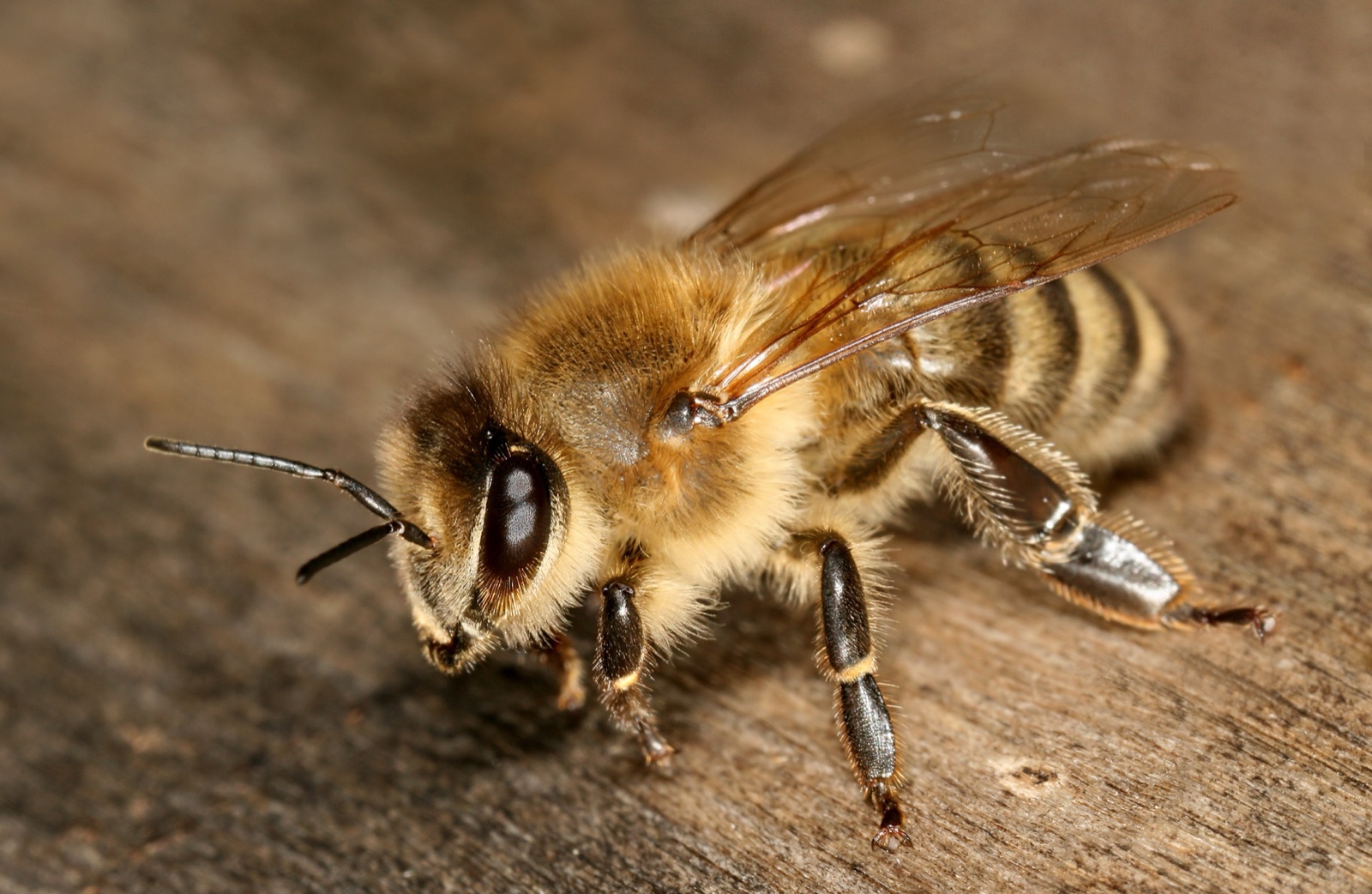
Honey bee (Apis mellifera carnica) at the hive entrance. Photo: Richard Bartz, CC BY-SA 2.5

However, in the chapter of the Qur’an called ‘The Bee’ (Surah An-Naḥl سورة النحل) bees are honoured above other insects and animals because Allah speaks to them directly, saying: “Your Lord revealed unto the bees ‘make your houses in mountains, in trees and in the hives they build for you. Then eat from all the fruits and humbly follow the paths of your Lord.’ A drink of different colours flows from within them in which is a cure for mankind. There is a sign in this for people who contemplate” (Q16:68-69). Usually, according to the Islamic understanding of prophecy, if someone receives وَحْي Waḥy (Revelation / Divine inspiration) then they are considered a prophet. So are bees prophets? The commentary in ‘The Study Quran’ says:
“The “revelation” to the bee may simply be a metaphorical way of referring to the innate, instinctual behaviors that God has implanted in the bee (R, Ṭs), although al-Rāzī suggests that it is at least possible that bees can be said to possess intelligence, including the ability to know God’s commands and prohibitions. Al-Rāzī argues that there is evidence of the bees’ intelligence in their construction of their hives and the perfectly symmetrical, hexagonal structures characteristic of them — the secrets of which elude even human intelligence — as well as their apparent social organization, headed by a leader recognized and obeyed by the rest. The idea that bees knowingly and consciously obey the commands “revealed” to them by God would be consistent with literal readings of other verses that describe all creatures as constituting an ummah, that is, a religious community (6:38), as glorifying and praising God (17:44; 57:1; 59:1, 24; 60:1; 61:1; 62:1; 64:1), or as “prostrating”.” (Nasr, Seyyed Hossein; Dagli, Caner K; Dakake, Maria Massi; Lumbard, Joseph E.B.; Rustom, Mohammed. The Study Quran: A New Translation and Commentary (p. 675). Kindle Edition).
In their book ‘The Cosmic Script’ Ahmed Moustafa & Stefan Sperl suggest that the bees’ revelation is displayed in their geometric skills, in their knowledge that the hexagon is the optimal form to contain honey. In this, bees are similar to the progenitor of classic Arabic calligraphy Ibn Muqla who based his geometry of letters on the hexagon. His contemporary Ibn az-Zanji said daringly of Ibn Muqla: “He is a prophet; handwriting in him was poured into his very hand even as it was revealed unto the bees to make their houses hexagonal”. Just as the hexagons in the beehive contain honey “in which there is a cure for mankind”, so the hexagons on which Arabic calligraphy is based contain the honey-like Quran which is “a cure for that which is in your hearts and a guidance and a mercy for those who believe" (Q10:57). Arabic calligraphy is also the art form which displays the 99 Beautiful Names of God (أسماء الله الحسنى) which are themselves ‘Physicians of the Heart’ (the name of a book on the 99 Names by Wali Ali Meyer et al).
Describing his research journey, Ahmed Moustafa said:
“the term misaha or ‘surface area’, which appears repeatedly in [Ibn Muqla’s] instructions, must be taken literally in the sense that it refers to the actual surface area occupied by the stroke which draws the letter form concerned. It thus became clear that previous reconstructions of Ibn Muqla’s theory . . . all had one major flaw: they were, in effect, one-dimensional and only reflected measurements relating to length but not to breadth. Once the thickness of the stroke was accounted for by correct understanding of the term masaha, the instructions suddenly appeared more meaningful and precise, and it became clear that Ibn Muqla’s theory is far more sophisticated than had so far been presumed. Covering both the length and breadth of the stroke of the pen, it operates not in one dimension only, but in two. In doing so, it takes account of the fact length and breadth of the stroke of the pen, it operates not in one dimension only, but in two. In doing so, it takes account of the fact that the stroke produced by the reed pen is analogous to a two-dimensional ribbon which moves and twists in space as though hinting at a third dimension. This peculiar way of moving gives the stroke the tangibility in space on which its calligraphic quality depends. It is a defining feature of this art form which no theory of Arabic calligraphy can afford to ignore.” What this meant was that Ahmed had to completely recreate his geometric grid from a square to a hexagon. He then “proceeded to design all letter shapes on that basis,” painstakingly “reconstructing some of the more complex letter shapes”. (Sugich, Michael. Hearts Turn: Sinners, Seekers, Saints and the Road to Redemption (pp. 179-180). Kindle Edition.)
Moustafa had rediscovered the Ibn Muqla’s secret, lost to generations of calligraphers who just learned to draw the letters by rote rather than by understanding first principles.
Perhaps the sign in all this for people of contemplation is that God’s mercy exists at multiple levels, demonstrating harmony at both the micro and macrocosmic levels. One should not disparage or belittle bees, because they are guardians of a great truth with the potential to heal both the small and the large, through the medicine they produce from their own tiny bodies and store in hexagons — which at a different cosmic level become containers for the medicine of the Qur’an and the Beautiful Names.