Posts

My Journey with Soul

Filed under Politics, Spirituality, Sufism, Uncategorized

My fascination with soul started in my teenage years with soul music, specifically black music. When I was eighteen I met a Sufi in Kashmir and asked him “do you understand the soul in music?”. He was playing a recording of what he described as ‘Kashmiri soul music’. His response was to read the ‘book’ in my heart and reveal an instruction to me. Through this revelation my felt need to develop soul was confirmed and made explicit, along with an instruction related to politics (hence the name of my blog).

Continue reading →

Constraint

Filed under Politics, Spirituality

Politics is born out of constraint as economics is born out of scarcity. Constraint can be understood as a limit to freedom. The irony of constraint is that, while it limits freedom, great human creativity and achievement arises from it. A good example is a jazz band. In this example, rhythm is the element of constraint. The musicians have freedom to express themselves and their instruments on top of the rhythm, but that freedom is not absolute if they want to maintain the format and structure of the groove. An exception to this would be ‘free jazz’, but generally people agree that the greatest jazz comes from a band keeping (or constrained by) time. The masters of jazz such as Coltrane demonstrate how much freedom and creativity is possible even when constrained. This is also true of politics. Humans are political animals as Aristotle said and our great achievements occur in a political context. Sometimes, unfortunately, the constraints are so harsh that they constitute oppression. In this case we could say that human achievements born from oppression occur +despite+ politics, and we could also justifiably say that oppression stifles human achievement and creativity. This is of course the challenge of the politician, to bring about a just state of affairs that allows human flourishing. The just politician will attempt to remove a number of ‘artificial’ constraints e.g. inadequate infrastructure and medical care, however (s)he will seek to educate people to work within a ’natural’ set of constraints such as the ecosystem and human social and cultural patterns. The human spirit itself is placed within a constrained set of circumstances - the body. The challenge of human life is spiritual freedom and expression within the body. It is only when we die that this challenge - and constraint - no longer applies.

Continue reading →

Sarvodaya

Filed under Economics, Gandhi, Spirituality

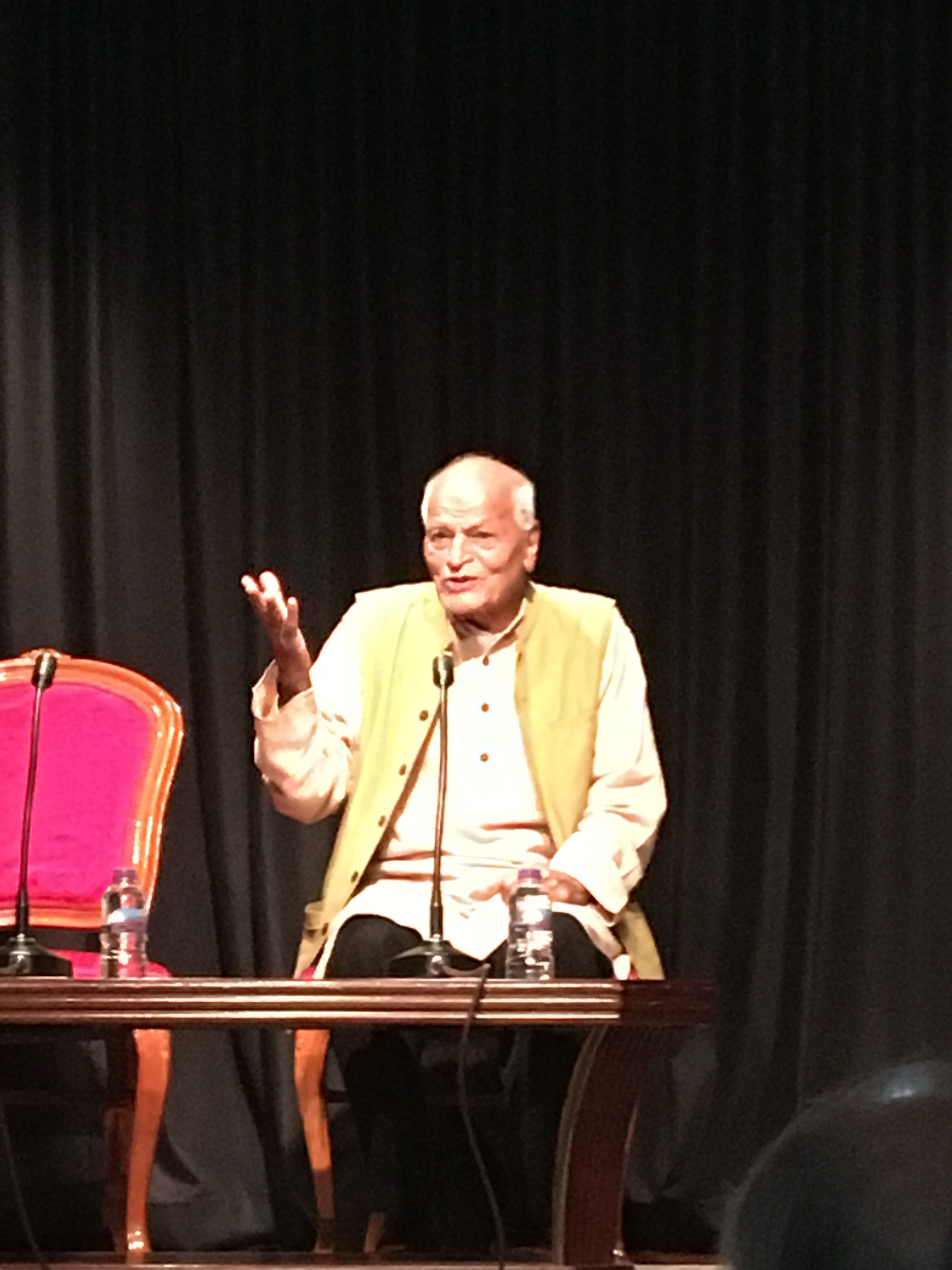
I attended the Gandhi Foundation’s annual lecture 2017 given by the wonderful Satish Kumar who exuded light.

Satish began his talk by describing the Gandhian ideal of service. This ideal had persuaded him to leave his Jain monastery at the age of 18 and come into the world because Gandhi taught that spirituality is not found in rituals but in service. We can make our work spiritual by adopting an attitude of service e.g. a teacher serving his pupils, a doctor serving her patients, a politician serving his constituents. In this way we bring together our profession and our vocation. Earning money and making a living is fine, but if we make our work an act of service then it becomes a spiritual practice. Gandhi showed how politics can be spiritual.

Continue reading → · 1 comment

The Spiritual Journey of Noah

Filed under Islam, Religion, Spirituality, Sufism

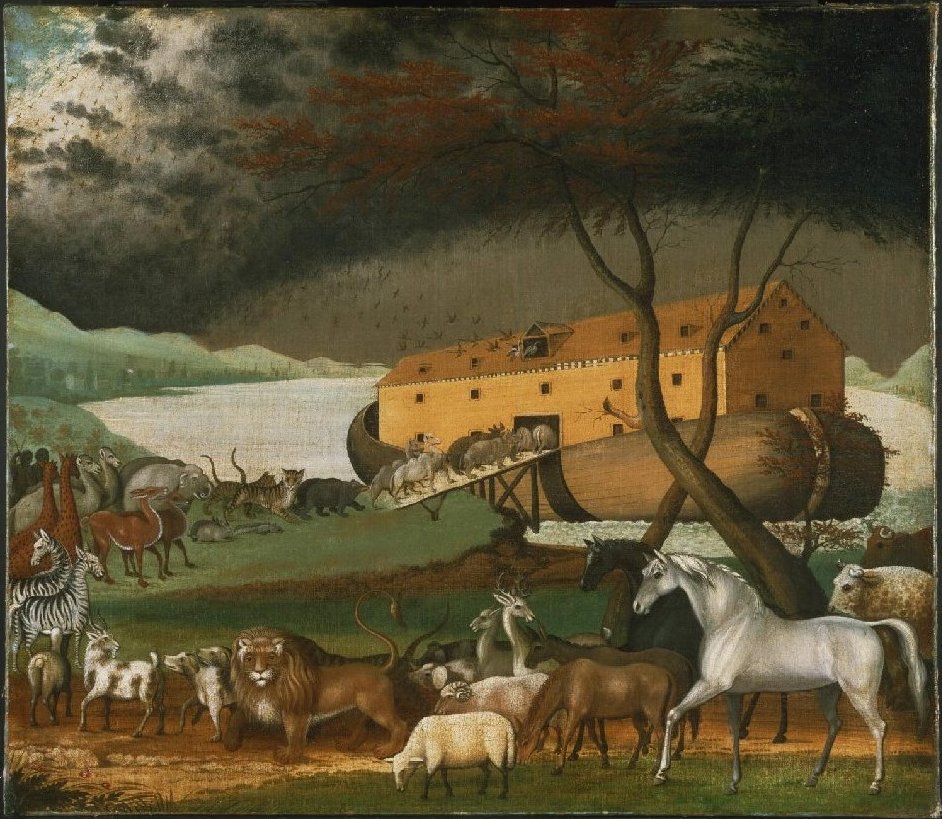
This text is an English translation of a Khutba (sermon) given in Spanish by Sidi Hashim Cabrera, specifically Khutba 4 from the book ‘Khutbas of Dar-as-Salam’. The Quranic translations are by Muhammad Asad, but I have done the translation from Spanish myself and am responsible for any errors. I have left many of the key Arabic terms untranslated, as per the original sermon. A key term is ‘maqaam’ meaning ‘spiritual station’. Another key term is ’nafs’ meaning ‘soul’.

Continue reading →

The Politics of Love

Filed under Politics, Spirituality

Political faultlines are determined by the limits of love. When analysing politics we typically focus on the areas beyond those limits, where the absence of love can be interpreted as hate. But no one wants to be identified as a hater because we like to see ourselves as lovers. In the aftermath of the Brexit referendum, despite the upswell of racism, Brexiteers deeply resented being identified with racism because they felt their own motivation to be love: love for their country as they understand it; love for Britishness as they know it; love for their community; love for people like them.

Continue reading →

Reflection on God's name 'Al Azim'

Filed under Islam, Religion, Spirituality, Sufism, Uncategorized

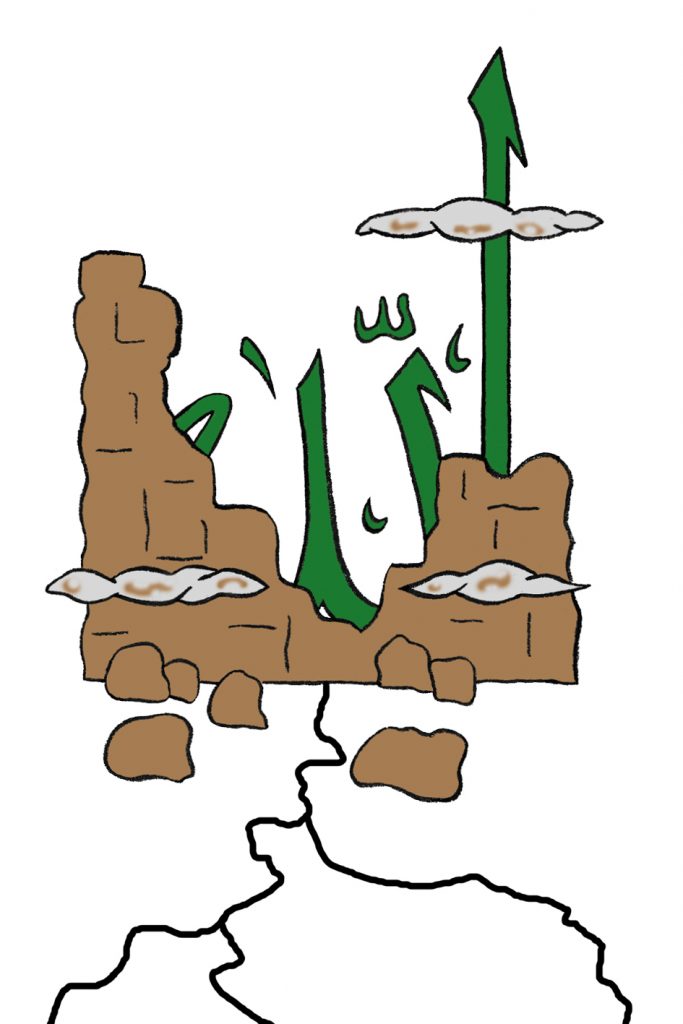
azim-crack-683x1024

Review of the chapter ‘Al Azim’ from the book ‘The 99 Names of God’ by Daniel Thomas Dyer

I find myself drawn to Allah’s names of majesty and wrath such as al-Azim, the Tremendous. Daniel chooses strong words and images on these pages: earthquakes, sinews, mountains, cracks and dust.

Through the cracks wrought by earthquake and mountain-splitting, there is always the leavening of light, which Daniel invokes using a Leonard Cohen quote. Daniel could have gone back to Rumi for the original but it is in the spirit of this wonderful book to embrace variety and diversity wherever possible.

Continue reading →

The Ninety-Nine Names of God

Filed under Islam, Religion, Sufism

Interior wall and dome ceiling of the Sheikh-Lotf-Allah mosque in Isfahan, Iran

Interior wall and dome ceiling of the Sheikh-Lotf-Allah mosque in Isfahan, Iran

The Muslim theologian Abdal Hakim Murad says “Sometimes we see in the world manifestations of the divine beauty and grace - and that’s preponderant - sometimes we see in the world manifestations of the divine rigour and wrath. And this is one of the big differences between our (Muslim) understanding and, say, the Christian understanding. The Christians say “God is love” and immediately they can’t explain the meningitis virus or whatever, and this is a major source of loss of faith amongst them.

Continue reading → · 1 comment

Humanism and Religion - part 2

Filed under Buddhism, Islam, Religion, Spirituality, Sufism

The principal reason why some religious teachers are not humanistic is because they distrust human nature and have a pessimistic view of human beings. These religious teachers tend to downplay the humanity of the founders of their religions, emphasing their superhuman or even divine qualities.

Traditional Christianity teaches that due to our Fall from the grace of Eden, humanity is in a state of sin and that this original sin passes from one generation to another as part of our human nature. The only redemption is considered to be through Christ, whose nature is believed to combine divinity with humanity. Therefore traditionally Christians were encouraged not to rely on or trust their corrupt human nature but instead to rely on the divine Christ their saviour.

Continue reading → · 2 comments

Humanism and Religion

Filed under Buddhism, Islam, Philosophy, Psychology, Religion, Spirituality, Sufism

It is possible to be both religious and a humanist. For me, humanism means attributing weight and importance to the individual human experience. Historically, some religious practioners have neglected the individual experience of themselves and others, preferring to prioritise the literal religious doctrine in all circumstances. However there is not necessarily a contradiction between religion and humanism.

An example of a non-humanistic approach to Buddhism would be to treat all individuals like pebbles on a beach and, rather than consider their own individual circumstances, encourage them simply to adhere to Buddhist doctrine in the expectation that it will resolve their problems. On the other hand, a humanistic approach would encourage the practice of meditation as a form of compassionate, internal listening, a pre-requisite for the sensitive integration of Buddhist teaching in your life.

Continue reading → · 1 comment

Sufism: traditional, modern, and post-modern

Filed under Religion, Sufism

Ludwig Wittgenstein

Ludwig Wittgenstein

I want to posit that the jump-off point between modern and post-modern philosophy is Ludwig Wittgenstein’s notion of language games. His point is that there are multiple human language games in operation simultaneously; each language game functions to establish a different type of truth, and the truth established by one language game may have only limited relevance to the truth established by another.

Science is a key language game. In the modern era the truths established by science have swept all before them and proponents of scientism claim that science has a monopoly on truth. However, in the post-modern era Wittgenstein’s notion of language games provides breathing space for other types of truth e.g. ethics; aesthetics; and religion.

Continue reading → · 2 comments