Category: Economics

Sarvodaya

Filed under Economics, Gandhi, Spirituality

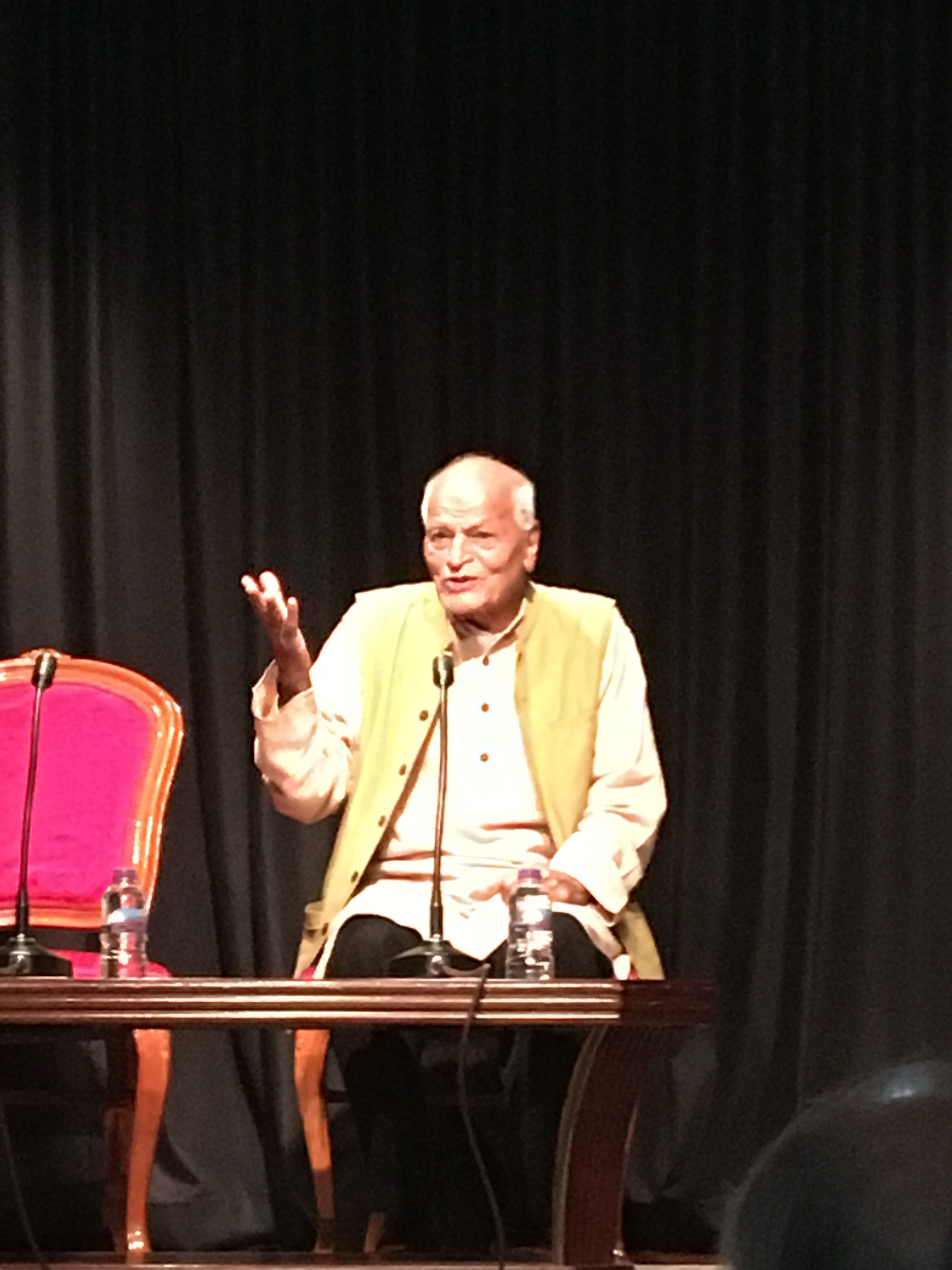
I attended the Gandhi Foundation’s annual lecture 2017 given by the wonderful Satish Kumar who exuded light.

Satish began his talk by describing the Gandhian ideal of service. This ideal had persuaded him to leave his Jain monastery at the age of 18 and come into the world because Gandhi taught that spirituality is not found in rituals but in service. We can make our work spiritual by adopting an attitude of service e.g. a teacher serving his pupils, a doctor serving her patients, a politician serving his constituents. In this way we bring together our profession and our vocation. Earning money and making a living is fine, but if we make our work an act of service then it becomes a spiritual practice. Gandhi showed how politics can be spiritual.

Continue reading → · 1 comment

The Bloom On Fruits

Filed under Economics

Most men, even in this comparatively free country, through mere ignorance and mistake, are so occupied with the factitious cares and superfluously coarse labors of life that its finer fruits cannot be plucked by them. Their fingers, from excessive toil, are too clumsy and tremble too much for that. Actually, the laboring man has not leisure for a true integrity day by day; he cannot afford to sustain the manliest relations to men; his labor would be depreciated in the market. He has no time to be anything but a machine. How can he remember well his ignorance – which his growth requires – who has so often to use his knowledge? We should feed and clothe him gratuitously sometimes, and recruit him with our cordials, before we judge of him. The finest qualities of our nature, like the bloom on fruits, can be preserved only by the most delicate handling. Yet we do not treat ourselves nor one another thus tenderly. Some of you, we all know, are poor, find it hard to live, are sometimes, as it were, gasping for breath.

Continue reading →

The Fetishisation Of The Market

Filed under Economics, Politics

Regarding public good vs business good, Anna Minton’s book ‘Ground Control’ describes how the urban planning process has been distorted in recent years in favour of business and against the public interest. Large sections of our cities (e.g. Liverpool 1) have now been privatised in order to provide lucrative shopping environments. Undesirables (e.g. young people, old people, homeless people) are excluded through various means, such as the ASBO.

The fetishisation of the private sector knows no bounds. The current Neoliberal Party government is being warned that withdrawing investment from the public sector too quickly will deepen the recession, because the private sector is not ready to take up the slack. One reason for this is because the banks are failing to lend. The proposed solution is more ‘quantitative easing’ - increasing the money supply so that the banks have more money to lend. But the evidence so far shows that banks use any additional money in the system to fatten their own balance sheets and pay bonuses, not to lend, no matter how many times Vince Cable ticks them off.

Continue reading →

The Moral Economy

Filed under Economics, Politics

Opposition to neo-liberalism can be summarised under the heading ’the moral economy’. In a moral economy, human beings accept moral responsibility for what happens in the economy. We stop pretending that if everyone pursues their own selfish interest an ‘invisible hand’ is going to magically bring about our collective good.

Accepting moral responsibility does not entail taking control of every aspect of the economy. We can accept that, in some areas, properly regulated markets work reasonably well. However, the provision of universal public services should not be left to the market but should be performed by the public sector. Natural resources such as oil and metals belong to us all, and should not be left to small cabals to exploit and profiteer. We need to consume only as much oil as we need to create new renewable energy systems - the rest should be left in the ground if we want to have a future.

Continue reading → · 1 comment

Babylon Must Fall

Filed under Economics, Politics

Neo-liberalism is an ideological blind faith in markets. Like all dogmas or pseudo-sciences, its adherents continue to grasp at it, regardless of how many facts and events prove that markets do not work. They endlessly chant the mantra “public bad, private good”.

As Derek Wall discusses in his book ‘Beyond Babylon’ there is a range of alternatives to neo-liberalism, ranging through Keynesian, regulatory, localist, eco-feminist, socialist and anarchist approaches, to name a few. They all have positive contributions to make, and all of us need to unite to slay the neo-liberal dragon.

Continue reading →

The Sufi Path of Service

Filed under Economics, Politics, Sufism

How can we distinguish between fatal and liberating choices? That was the question posed this week by Sheikh Aly N’Daw, head of the International Sufi School. He was speaking at his book launch in Westminster, which was hosted by Ian Stewart MP, chair of the All-Party Parliamentary Friends of Islam group. Aly N’Daw is from the Mouride school of Sufism founded by the Senegalese saint Amadou Bamba (1850-1927) who emphasised service to others as the path to God. Sheikh Aly encourages his students to study the lives of great men and women who have bridged the gap between politics and spirituality, and have demonstrated how peace within leads to peace in the world.

Continue reading →

Increasing Equality

Filed under Economics, Politics

According to Lord Griffiths, the Conservative peer and Vice-Chairman of investment bank Goldman Sachs “we have to accept that inequality is a way of achieving greater opportunity and prosperity for all”. Has he hit on a clever, counter-intuitive truth? No, he is just plain wrong.

In their book The Spirit Level, Richard Wilkinson and Kate Pickett show that practically all the problems of modern societies, from child mortality to drug addiction, mental illness to obesity, murder rates to environmental pollution, have the same root cause – inequality.

Continue reading → · 1 comment

The 'Real' Economy

Filed under Economics, Politics

With financial meltdown seemingly averted, eyes are now turning to the ‘real’ economy. What exactly is the ‘real’ economy? It is important to distinguish fundamental investment from the manic-depressive behavior of ‘Mr. Market’. And then it is important to distinguish truly productive investment from investment which is merely profitable. Gambling is an example of an ‘industry’ which is extremely profitable but entirely counter-productive.

Continue reading →

The View From Iceland - by Elin Agla Briem

Filed under Economics, Politics

Once After a hard day’s forage Two bears sat together in silence On a beautiful vista Watching the sun go down And feeling deeply grateful For life.

Though after a while A thought-provoking conversation began Which turned to the topic of Fame.

Then one bear said, “Did you hear about Rustam? He has become famous And travels from city to city In a golden cage;

He performs to hundreds of people Who laugh and applaud His carnival Stunts.”

Continue reading → · 1 comment

Unwilling Participants in the Casino

Filed under Economics, Politics

In her book ‘Casino Capitalism’ (1986) the respected political economist Susan Strange wrote:

“The great difference between an ordinary casino which you can go into or stay away from, and the global casino of high finance, is that in the latter we are all involuntarily engaged in the day’s play. A currency change can halve the value of a farmer’s crop before he harvests it, or drive an exporter out of business. A rise in interest rates can fatally inflate the costs of holding stocks for the shop-keeper. A takeover dictated by financial considerations can rob the factory worker of his job. From school-leavers to pensioners, what goes on in the casino in the office blocks of the big financial centres is apt to have sudden, unpredictable and unavoidable consequences for individual lives. The financial casino has everyone playing the game of Snakes and Ladders.”

Continue reading →