Category: Religion

Art and Creativity in Islam

Filed under Islam, Religion, Spirituality, Sufism

713px-Alhambra-p3-closeup

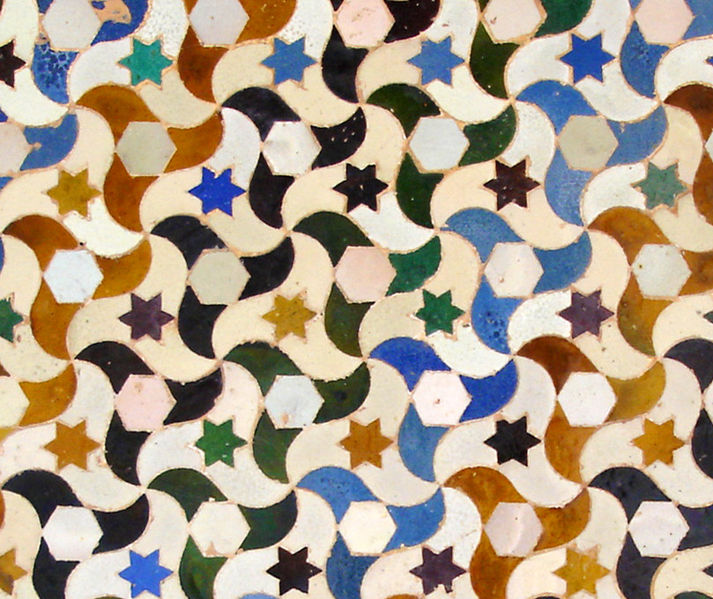
Tile from the Alhambra, Granada, Spain

Islam places creativity and art at the centre of human existence. Everything humans produce has an aesthetic quality, even the way we drive or speak. Art is the ability to generate beauty and we can all be artists in whatever we do, by doing it beautifully. This is ihsan. For example, our relationships need the quality of ihsan. Sound relationships are creative, and are based on the recognition of others’ souls. Human beings are the summit of creation, not to exploit others but to help the rest of creation to flourish. The Muslim as khalifa is a gardener, an artist, a carer of ophans. If we behave in these beautiful ways we will naturally embue our surroundings with beauty, just as the “classical mosques were built in the form of peoples’ souls” (1) as natural expressions of beauty rather than deliberate artistic creations.

Continue reading → · 1 comment

Post-Modern Religion

Filed under Buddhism, Religion, Spirituality

Modernism_to_Postmodernism_Passage

Passage from modern to post-modern era according to Hiroki Azuma in "Génération Otaku - Les enfants de la postmodernité"

I would like to compare attitudes to religion across three periods of history: the traditional period, the modern period, and the post-modern period. Religions are generally associated with the traditional period, when they held sway, whereas the modern period is characterised by religion’s loss of dominance. It should be noted that different people, countries and areas of the world are at different points in the cycle: even within the same city it is possible to find modern and even post-modern people living in close proximity with traditional people.

Continue reading → · 3 comments

Spiritual Constrictions

Filed under Religion, Spirituality

Celtic_Gold-plated_Disc%2C_Auvers-sur-Oise%2C_Val-d%27Oise_%28Detail_02%29

Based on the Taoist notion of Yin-Yang, I would like to introduce the idea of a ‘Yin’ constriction. (Please bear with me if you are already familiar with the basic concepts). Yin and Yang represent the two different aspects of the cosmos (similar to Jamal and Jalal in Islam). Yin and Yang have many different characteristics, which are all essentially relative, so I am not talking in absolutes here. In relation to each other, Yin is passive and Yang is active, Yin is yielding and Yang is penetrating, Yin is unstructured and Yang is structured, and Yin is soft and Yang is hard. As the popular Yin-Yang symbol suggests, cosmic balance is achieved when Yin and Yang are in balance with each other, and neither predominates overall.

Continue reading →

Kashmiri Sufism and the Yogini Lal Ded

Filed under Religion, Sufism

LalDed

Yogini Lal Ded

The two founding figures of Kashmiri Sufism are Sheikh Nooruddin Noorani (1377 - 1440 CE) and Sheikh Ali Hamadani (1314 - 1384 CE). Both of them are said to have encountered a female Hindu yogini called Lal Ded (1320 - 1392 CE) who was in the habit of wandering around naked.

One story of Lal Ded mentions how she was teased by a number of children. A nearby cloth merchant scolded the children for their disrespect. Lal Ded asked the merchant for two lengths of cloth, equal in weight. That day as she walked around naked, she wore a piece of cloth over each shoulder and, whenever she was met with respect or scorn, she tied a knot in one or other cloth. In the evening, she brought the cloths back to the merchant, and asked him to weigh them again. Both cloths were equal in weight no matter how many knots were in each, showing that respect and scorn have no weight of their own.

Continue reading →

Varieties Of Liberation Theology

Filed under Politics, Religion

Liberation Theology is normally associated with Latin American Catholicism. However, it can be understood as a radical tendency existing within all the major world religions, which each contain currents emphasising the following themes:

* working with the poor * challenging authority * seeking liberation in this life as well as the next * favouring activism over contemplation

CHRISTIANITY Liberation theology focuses on the needs of the poor and, in their interest, is prepared to challenge political and ecclesiastical hierarchies. In Latin America, the prototype was Bartolomé De Las Casas (1484 - 1566), a Dominican priest who became Bishop of Chiapas (the area which in recent times gave birth to the Zapatista movement). Against the grain of Spanish colonialism, De Las Casas envisioned a just society where indigenous people would co-exist peacefully and freely with the colonists instead of as slaves.

Continue reading →

Reflections On Satyagraha

Filed under Politics, Religion

Activating our soul isn’t easy, and finding a way to change the world through soul-power (God we need it) can be even harder. This is the meaning of Satyagraha, the term first introduced by Mahatma Gandhi to describe his campaign in South Africa, now made into an opera by Philip Glass. Satyagraha the opera places Gandhi’s life in a mythological context, showing how Gandhi was first inspired by the Bhagavad Gita and the figures of Tagore and Tolstoy, and how he in turn came to be an inspiration to others, notably Martin Luther King.

Continue reading →

Fundamentalism and Interpretation

Filed under Religion, Sufism

Major religious figures such as the Buddha, Moses, Jesus and Mohammed revealed eternal truths in specific times and places. The truths they revealed must be understood within those contexts. We might prefer, if it were possible, to receive the eternal truth context-free, but then we would be even less able to relate it to our own lives and draw practical conclusions. Even though the world has changed since our great religious teachers, the basic context – being human – has not.

Continue reading →

Politics and Religion

Filed under Politics, Religion, Sufism

The two basic points are 1) every religion has a valid political dimension 2) every religion has suffered from being harnessed to political interests which have no basis in religion.

Buddhism has a valid political dimension. The Buddha gives clear advice to rulers in the Kutadanta and Cakkavatti-Sihanada Suttas. Islam and Judaism have more obvious political dimensions because both Mohammed and Moses were law-givers. The Qur’an and Torah both provide the bases for legal systems to govern polities of various shapes and sizes.

Continue reading →

Forgiveness

Filed under Religion

January 2008

As many of us come from a Christian background, one of the main things we consciously or unconsciously expect from a religion is forgiveness. Christianity’s starting point is our imperfection, our inability to keep moral laws (mitzvah), the fact that we are ‘sinners’. Christ embodies God’s forgiveness. His role is to restore our relationship (Covenant) with God despite the fact that we are unable to keep moral discipline ourselves.

Continue reading →

An Interview with Humanists - by Sally Bannister

Filed under Philosophy, Religion

April 2009

Jane Bannister is chairperson of Dorset Humanists and is involved in Bournemouth’s Big Green Fortnight in May 2009.  Dennis Bannister is currently holding a series of talks on Evolutionary Theory at Bournemouth U3A.  In this interview, they both give their personal take on the Humanist perspective.  Their responses are not necessarily representative of the Dorset Humanist group or the British Humanist Association.  They both embrace a secular approach to Humanism.  The interview begins as a formal Q&A session and evolves into a more in depth discussion, particularly regarding the issue of dogma. Sally Bannister: What does the word ‘Humanism’ mean to you?

Continue reading →