Category Archives: Uncategorized
Awrad-i-Fathiah-(author Mir Sayid Ali Hamdani d.786 AH)-English translation.

اوراد فتحيه AWRADI-FATHIA Hazrat Amir Kabir Mir Sayid Ali Hamadani (RA) has authored many books and pamphlets in Arabic and Persian, which lay stress…
Awrad-i-Fathiah-(author Mir Sayid Ali Hamdani d.786 AH)-English translation.

My Journey with Soul

My fascination with soul started in my teenage years with soul music, specifically black music. When I was eighteen I met a Sufi in Kashmir and asked him “do you understand the soul in music?”. He was playing a recording of what he described as ‘Kashmiri soul music’. His response was to read the ‘book’ in my heart and reveal an instruction to me. Through this revelation my felt need to develop soul was confirmed and made explicit, along with an instruction related to politics (hence the name of my blog).
Politics can be understood as the balancing and harmonising factor of soul. However, nowadays when people hear the word ‘politics’ they inevitably think of its shadow qualities. In the context of soul these represent the struggle of the soul to reconcile inner and outer conflicts and competing interests, and sometimes the corruption which results from such enormous challenges.
I was drawn to soul music because of its rawness, authenticity and spirituality. All of these were a relief and medicine for me as a teenager, growing up in a middle-class London environment where the mainstream culture was more repressed and my father had recently died. I loved the way soul music came from the heart – as someone whose education and milieu was all about coming from the head. I wanted to develop and embody soul qualities myself.
Following my meeting with the Sufi and some initiatory experiences soon after, my quest for soul took a more Eastern turn and I started to try techniques such as t’ai chi, yoga and meditation. At the time I had no concept of Sufism and I wasn’t drawn to Islam.
After leaving university I lived in a Buddhist retreat centre for a period and gained experience of meditation, which confirmed my belief in a soul imbued with imaginative properties, also characterised by compassion and connectedness. These are key aspects of the soul’s ‘politics’: it has transpersonal, expansive qualities and should not be considered narrowly individual.
Nowadays I experience my soul through Sufi meditation practices such as Dhikr and Sama’a and also through 5 Rhythms dance where I allow my soul to rip!
Reflection on God’s name ‘Al Azim’
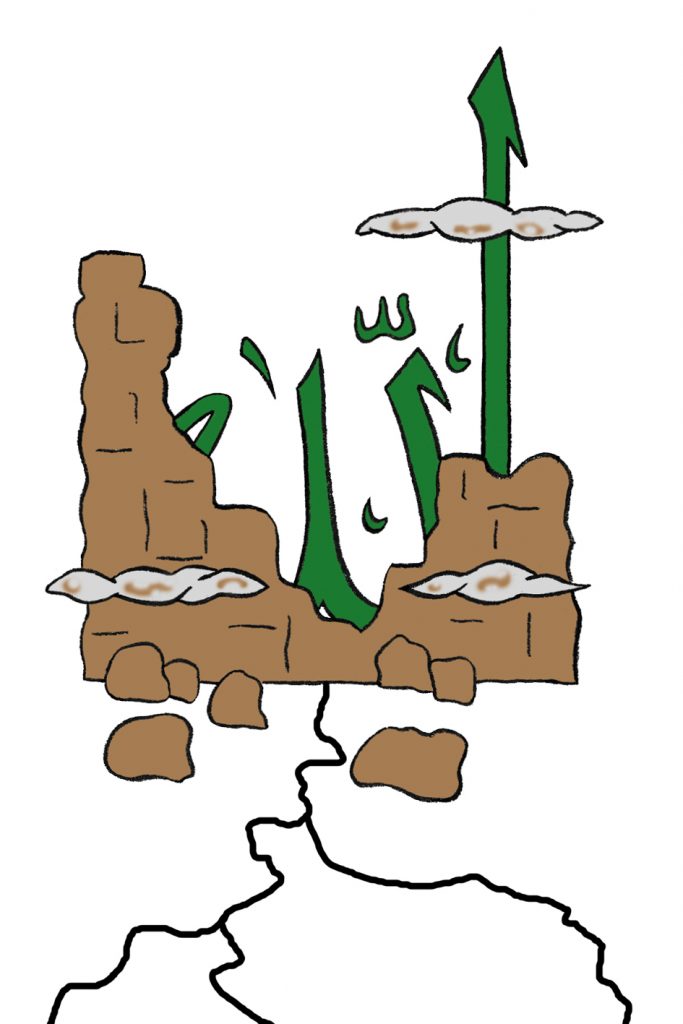
Review of the chapter ‘Al Azim’ from the book ‘The 99 Names of God’ by Daniel Thomas Dyer
I find myself drawn to Allah’s names of majesty and wrath such as al-Azim, the Tremendous. Daniel chooses strong words and images on these pages: earthquakes, sinews, mountains, cracks and dust.
Through the cracks wrought by earthquake and mountain-splitting, there is always the leavening of light, which Daniel invokes using a Leonard Cohen quote. Daniel could have gone back to Rumi for the original but it is in the spirit of this wonderful book to embrace variety and diversity wherever possible.
Just as light brightens cracks, the book reminds us how the awe expressed in the Prophet Muhammad’s earnest prayer of submission was softened, by his allowing his beloved grandsons Hassan and Hussein to climb and play on him as he prayed.
Meditating on Daniel’s picture of a wall destroyed by an earthquake to reveal the name ‘Allah’ behind, I recall the Hadith Qudsi “I am with those whose hearts are broken for My sake” and I dig out these words of Rumi: “Wherever there is a ruin there is hope for a treasure – why do you not seek the treasure of God in the wasted heart?”
I recall the powerful idea of being broken (shikast) as an initiatory stage on the path to God, which seems closely related to al-Azim. Daniel echoes the question from the Qur’an: Who could give life to bones that have crumbled to dust? It will be inspiring for readers to contemplate the answer.
I think that The 99 Names of God by Chickpea Press is a tremendous achievement, and I hope it will bring light and hope to many people.

The Covenants of the Prophet Muhammad with the Christians of the World

 The recent scholarship of The Covenants Initiative highlights how the Prophet Muhammad (peace be upon him) sought to protect Christian communities, not only in his own lifetime but for perpetuity.
The Initiative is based around the research of Dr John Andrew Morrow, whom some at Rumi’s Circle had the pleasure of meeting not long ago. Dr Morrow has rediscovered (and often translated afresh) texts authored by the Prophet Muhammad that state that Muslims should defend peaceful Christian communities ‘until the End of the World’. In his book, The Covenants of the Prophet Muhammad with the Christians of the World, we discover that the Prophet made the following promise to Christians:
I grant security to them, their churches, their businesses, their houses of worship, the places of their monks, the places of their pilgrims, wherever they may be found, be they in the mountains or the valleys, caves or inhabited…
View original post 684 more words
 Politics of Soul