Blog Archives

Sarvodaya
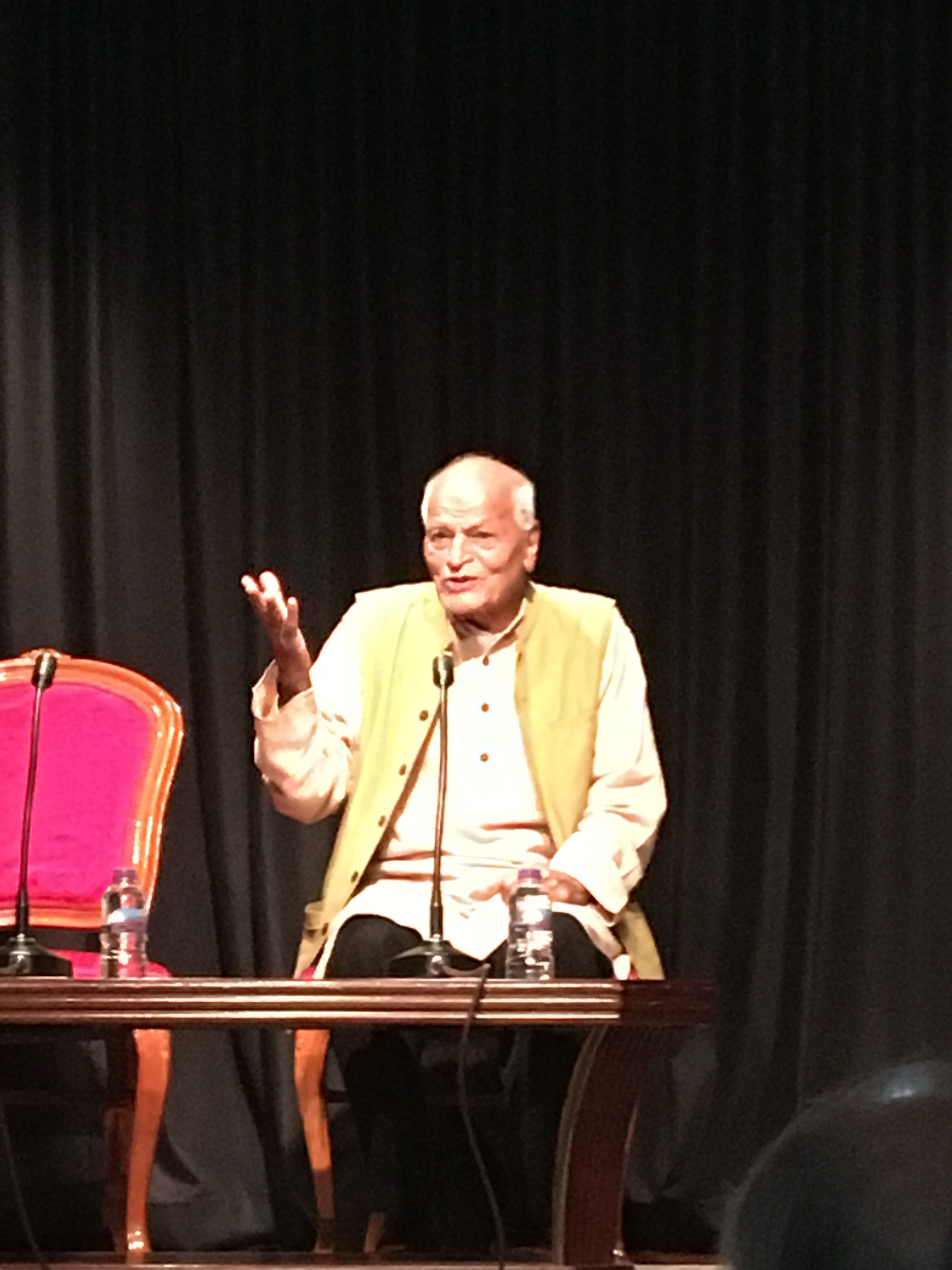
I attended the Gandhi Foundation’s annual lecture 2017 given by the wonderful Satish Kumar who exuded light.
Satish began his talk by describing the Gandhian ideal of service. This ideal had persuaded him to leave his Jain monastery at the age of 18 and come into the world because Gandhi taught that spirituality is not found in rituals but in service. We can make our work spiritual by adopting an attitude of service e.g. a teacher serving his pupils, a doctor serving her patients, a politician serving his constituents. In this way we bring together our profession and our vocation. Earning money and making a living is fine, but if we make our work an act of service then it becomes a spiritual practice. Gandhi showed how politics can be spiritual.
The irony is that if we are just trying to looking after ourselves then we will feel miserable, whereas if we try to serve others then we will experience joy. [To quote another spiritual teacher, “if you want to be selfish be wisely selfish”]. The best way we can help ourselves is to help others.
Whereas other political ideologies such as socialism or utilitarianism just think in terms of improving human society and “the greatest good for the greatest number”, Gandhi proposed the ideal of Sarvodaya meaning ‘the upliftment of the whole’. The ‘whole’ includes all species, and all people – we need to benefit all, not just the majority.
We need to benefit all species: elephants, lions, snakes, earthworms. Satish spoke movingly about the work that earthworms perform (without wages, holidays, or going on strike!) of turning the earth, making it soft and friable. Apparently each earthworm turns 6 tons of soil in its lifetime. When Satish sees an earthworm in his garden he thanks it.
We need an economy that is based on valuing work, on growing food, on community, on crafts, on arts. The prefix ‘eco’ in economy and ecology comes from the Greek word ‘ecos’ meaning ‘house’, and their real ‘eco’ meaning is about building and respecting our abode, the earth. However, our current economic system does not do this, instead it is a ‘moneyconomy’, all about increasing the amount of money without regard for the creation of actual value. Activities such as prostitution, and police responses to terrorism all add up in the moneyconomy but they do not really add value to our abode. The true economy should measure welfare, and there is potentially no limit to this because it is a function of the human soul, individually and communally. There is no real separation between individual and community: “I am because you are”.
Varieties Of Liberation Theology
Liberation Theology is normally associated with Latin American Catholicism. However, it can be understood as a radical tendency existing within all the major world religions, which each contain currents emphasising the following themes:
* working with the poor
* challenging authority
* seeking liberation in this life as well as the next
* favouring activism over contemplation
CHRISTIANITY
Liberation theology focuses on the needs of the poor and, in their interest, is prepared to challenge political and ecclesiastical hierarchies. In Latin America, the prototype was Bartolomé De Las Casas (1484 – 1566), a Dominican priest who became Bishop of Chiapas (the area which in recent times gave birth to the Zapatista movement). Against the grain of Spanish colonialism, De Las Casas envisioned a just society where indigenous people would co-exist peacefully and freely with the colonists instead of as slaves.
In the 20th Century, an important figure was Archbishop Oscar Romero of San Salvador, assasinated in 1980. Previously a conservative, Romero inclined to liberation theology after a Jesuit colleague was killed for creating self-reliant groups among poor peasants. When the government refused to investigate, Romero spoke out against poverty, social injustice, assasinations and torture, until the death squads killed him too.
HINDUISM
Within Hinduism, Gandhi pioneered liberation theology. He successfully challenged the colonial power, and he also challenged the orthodox Hindu authorities, particularly with regard to untouchability, which led to his assasination by a Hindu extremist in 1948. Gandhi practiced karma yoga, the path to liberation through work, which in his case meant social and political activism. Gandhi combined the traditional Indian ideal of non-violence (ahimsa) with the Christian ideal of active love, to produce satyagraha, the theory and practice of non-violent direct action. Later, satyagraha was successfully adopted by Martin Luther King, another major figure in the history of liberation theology.
ISLAM
Sheikh Amadou Bamba of Senegal (1853 – 1927) offers a great example of liberation theology in an Islamic context. Founder of the Mouride Sufi movement, Bamba led a non-violent struggle against French colonialism. The French exiled and tortured him, which only strengthened his movement. Notably, Bamba emphasised work as a spiritual practice, and his followers are renowned for their industriousness, being involved in many economic enterprises throughout Senegal, such as groundnut cultivation.
BUDDHISM
In Sri Lanka the Sarvodaya Shramadana movement uses traditional Buddhist teachings such as the Four Noble Truths and the Wheel of Life to improve worldly conditions such as sanitation and food cultivation.
Reflections On Satyagraha
Activating our soul isn’t easy, and finding a way to change the world through soul-power (God we need it) can be even harder. This is the meaning of Satyagraha, the term first introduced by Mahatma Gandhi to describe his campaign in South Africa, now made into an opera by Philip Glass. Satyagraha the opera places Gandhi’s life in a mythological context, showing how Gandhi was first inspired by the Bhagavad Gita and the figures of Tagore and Tolstoy, and how he in turn came to be an inspiration to others, notably Martin Luther King.
At the start of the opera we see Gandhi inhabiting the mythical battlefield between the Pandava and Kaurava clans, together with the hero Arjuna and the god Krishna. Just as Arjuna is caught between the competing claims of the two clans, towards both of whom he feels loyalty, so Gandhi is caught between the rival claims of the British empire and the Indian people, towards both of who he feels loyalty. Just as Arjuna’s soul (Atman) is activated by Krishna’s wise counsel that he must have the courage to do his duty in the face of life’s conflicts, so too is Gandhi’s. The scene ends with the solemn vow of Brahmacarya, as Gandhi / Arjuna promises to dedicate his life to courageous service.
Mobilising the soul as an active force in human politics and the affairs of the world is no easy task, and Gandhi draws hostility, ridicule and even violence upon himself as he adopts the dress and lifestyle of a renunciate. Yet the ways of the spirit are subtle, and profoundly affect the human sphere through what appear, on the surface, to be simple acts, but which are imbued with great symbolism and resonance. We see this played out as Gandhi and his followers burn their identity cards (‘passes’) to protest against the racist laws of the time. This simple act is incredibly liberating, both spiritually and politically, and lifts them to a new plane of existence.
Satyagraha is ‘the surgery of the soul’, because it is a method for bringing about a profound change of heart in ourselves and others which leads to political and social change. The Satyagrahi must be courageous and willing to sacrifice his or her own well-being in order to demonstrate truth. It is only the courageous demonstration of truth that can touch the soul of the oppressor, and cause him to change or at least relent. This, finally, is the meaning of Satyagraha – that profound, long-lasting change, whether personal or political, must originate from within, and the only method that ultimately works is one based on understanding and harnessing the soul.
Increasing Equality
According to Lord Griffiths, the Conservative peer and Vice-Chairman of investment bank Goldman Sachs “we have to accept that inequality is a way of achieving greater opportunity and prosperity for all”. Has he hit on a clever, counter-intuitive truth? No, he is just plain wrong.
In their book The Spirit Level, Richard Wilkinson and Kate Pickett show that practically all the problems of modern societies, from child mortality to drug addiction, mental illness to obesity, murder rates to environmental pollution, have the same root cause – inequality.
“It became clear,” according to Wilkinson, “that countries such as the US, the UK and Portugal, where the top 20% earn seven, eight or nine times more than the lowest 20%, scored noticeably higher on all social problems at every level of society than in countries such as Sweden and Japan, where the differential is only two or three times higher at the top.”
We all know that the endless pursuit of economic growth is crazy, that higher GDP is a meaningless quest that does nothing to increase our collective happiness or well-being. What Wilkinson and Pickett show is that we must measure our society’s success in terms of increasing equality, because this is the only reliable recipe for “greater opportunity and prosperity for all”.
httpv://www.youtube.com/watch?v=iAScgcrXlXE
Gandhi famously said:
“I will give you a talisman. Whenever you are in doubt, or when the self becomes too much with you, apply the following test. Recall the face of the poorest and the weakest man whom you may have seen and ask yourself if the step you contemplate is going to be of any use to him. Will he gain anything by it? Will it restore him to a control over his own life and destiny? In other words, will it lead to swaraj for the hungry and spiritually starving millions? Then you will find your doubts and your self melt away.”
Tackling poverty is essential if we are to achieve an equal and just society. So is confronting greed. Although the Labour government has taken certain steps towards reducing poverty, such as introducing family tax credits, they have done nothing to restrain the rapacious behaviour of the economic elites. Peter (now Lord) Mandelson said in 1998 “we are intensely relaxed about people getting filthy rich”. We now see the damage that this laissez-faire attitude has caused, and is still causing.
So what is the answer, redistribution of wealth? In fact the first thing we need to do is STOP redistributing wealth. The current system is set up to redistribute wealth from the poor to the rich. We see this clearly in the bailout of the banking system, where we have all dug deep into our pockets to keep the bonus culture afloat. We see it evidently in the various forms of privatisation, taking property that previously belonged to us all, and handing it to a small section of the population. We see the government choose to fund public infrastructure through expensive private finance, when it could borrow the money itself at much lower rates of interest. All of this is designed to make the taxpayer fund the profits of private corporations. It is not sour grapes to say “enough is enough”, it is a sane recognition that for as long as the ever-widening gulf of inequality in our society is allowed to grow, we will become sicker, fatter, and more likely fall victim to crime and violence.
 Politics of Soul