Blog Archives

Sarvodaya
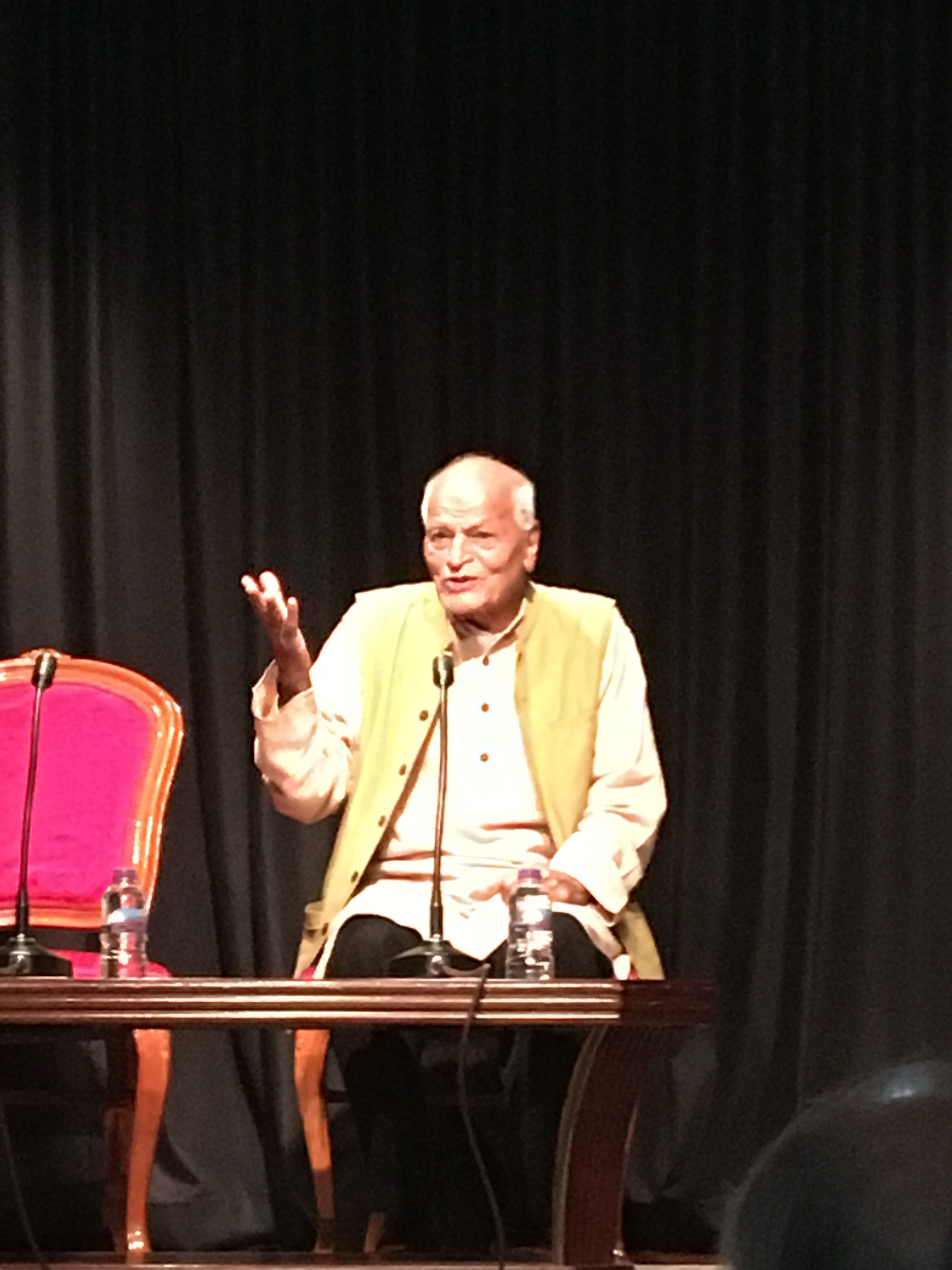
I attended the Gandhi Foundation’s annual lecture 2017 given by the wonderful Satish Kumar who exuded light.
Satish began his talk by describing the Gandhian ideal of service. This ideal had persuaded him to leave his Jain monastery at the age of 18 and come into the world because Gandhi taught that spirituality is not found in rituals but in service. We can make our work spiritual by adopting an attitude of service e.g. a teacher serving his pupils, a doctor serving her patients, a politician serving his constituents. In this way we bring together our profession and our vocation. Earning money and making a living is fine, but if we make our work an act of service then it becomes a spiritual practice. Gandhi showed how politics can be spiritual.
The irony is that if we are just trying to looking after ourselves then we will feel miserable, whereas if we try to serve others then we will experience joy. [To quote another spiritual teacher, “if you want to be selfish be wisely selfish”]. The best way we can help ourselves is to help others.
Whereas other political ideologies such as socialism or utilitarianism just think in terms of improving human society and “the greatest good for the greatest number”, Gandhi proposed the ideal of Sarvodaya meaning ‘the upliftment of the whole’. The ‘whole’ includes all species, and all people – we need to benefit all, not just the majority.
We need to benefit all species: elephants, lions, snakes, earthworms. Satish spoke movingly about the work that earthworms perform (without wages, holidays, or going on strike!) of turning the earth, making it soft and friable. Apparently each earthworm turns 6 tons of soil in its lifetime. When Satish sees an earthworm in his garden he thanks it.
We need an economy that is based on valuing work, on growing food, on community, on crafts, on arts. The prefix ‘eco’ in economy and ecology comes from the Greek word ‘ecos’ meaning ‘house’, and their real ‘eco’ meaning is about building and respecting our abode, the earth. However, our current economic system does not do this, instead it is a ‘moneyconomy’, all about increasing the amount of money without regard for the creation of actual value. Activities such as prostitution, and police responses to terrorism all add up in the moneyconomy but they do not really add value to our abode. The true economy should measure welfare, and there is potentially no limit to this because it is a function of the human soul, individually and communally. There is no real separation between individual and community: “I am because you are”.
The Beautiful Irony
A valid comparison can be drawn between money addicts and heroin addicts. Neither group can be trusted, but it is not appropriate to hate either heroin or money addicts because they are both sick. Addicts shouldn’t be allowed to run our industries or invest our money but we shouldn’t hate them. They are not in control of their own behaviour – they are not themselves. Not being themselves, they are incapable of experiencing empathy and compassion. The beautiful irony is that the self is entirely unselfish when it is at its healthiest. Only the diseased self, full of fear and insecurity, grasps onto what it perceives as “mine” at the expense of other people.
Elite education can drive out co-operative instincts like empathy and compassion. However I don’t think this is inevitable, and I believe it is possible to learn techniques of intellectual and emotional self-defence to protect against this brutalising effect. These techniques are widely applicable because, as George Monbiot points out (1), in modern society we are besieged by advertisements trying to undermine our healthy, intrinsic self-worth. Through causing alienation, corporations seek to refocus our self-esteem around their superficial products and brands, and delude us into pointless competition against each other.
Fitra is the Islamic concept of the underlying purity of the self. Fitra means ‘pure primordial nature’ or ‘basic goodness’ and is an Arabic word appearing in the Qur’an. The Prophet Muhammad (saws) said that every child is born with perfect fitra (1). Subsequent human impurities are ‘adventitious’, i.e. they arise due to upbringing, circumstance etc. Muslims believe that Islam is the religion which perfectly expresses this pure primordial nature because fitra is naturally drawn to the One God, to Whom the Muslim monotheistic practice of tawhid is the best path.
In his essay ‘Fitra: An Islamic Model for Humans and the Environment’ (2) the Sufi scholar and leader Saadia Khawar Khan Chishti discusses the relationship between fitra and care for the environment. He argues that spiritually healthy people (whose fitra is being well expressed) will naturally care for the environment and other people. For example, they will naturally be contented and will not require large quantities of consumer goods. He therefore argues that the solution to the environmental crisis must have a spiritual element – namely the clearing away of obstructions to fitra. Non-spiritual solutions on their own will not suffice.
The concept of fitra is similar to the concept of ‘Buddha nature’, which is also described as our natural, primordial purity. Buddhists believe in the interdependence of all life, and say that our Buddha nature is best expressed when we break down the egotistical barriers that falsely separate us from others. Therefore they say that “compassion is our Buddha nature” because, without a false ego and a diseased sense of self, like the Buddha we will naturally empathise with the suffering of others and want to relieve it.
***
1. George Monbiot, The Values of Everything (http://www.monbiot.com/archives/2010/10/11/the-values-of-everything/)
2. Sahih al-Bukhari, Volume 2, Book 23, Number 441. “No child is born except in al-fitra and then his parents make him Jewish, Christian or Magian (Zoroastrian), as an animal produces a perfect young animal: do you see any part of its body amputated?”
Sustainability & Autonomy
In order for any system to be sustainable (i.e. viable over a long period) all of its components must have a high degree of autonomy. The reason why natural ecosystems are sustainable (if humans don’t destroy them) is because their components such as plants and animals are autonomous. Plants, for example, autonomously photosynthesize and extend their roots to draw nutrients from the soil. Meanwhile, herbivores autonomously nourish themselves by eating plants, and carnivores by eating herbivores etc.
All systems face two principal types of threat: internal and external. External threats are many and varied: depending on the system they include strikes by meteorites, flu epidemics, bank failures and so on. A typical internal threat to a system is when one of its sub-systems predominates at the expense of the others, annexing a disproportionate share of the system’s resources and threatening the very survival of the whole, including the dominant sub-system itself.
Every viable system has a sub-system responsible for preserving the whole, and for maintaining the system’s essential organizing characteristics over time. The Chilean biologist Humberto Maturana called this sub-system ‘autopoietic’, meaning ‘self-making’ in Greek. The British cybernetician Stafford Beer coined the phrase ‘pathological autopoiesis’ to describe a situation where this sub-system malfunctions, and attempts to preserve itself at the expense of the whole. It starts to construe ‘self’ too narrowly, mistaking the welfare of the sub-system for the welfare of the whole system.
Our modern political sphere is full-to-overflowing with examples of pathological autopoiesis, where elements of government or public life which are supposed to benefit the whole merely seek to preserve or enrich themselves. Banks and MPs are two obvious examples. Typically these pathological sub-systems protest that they are acting in the interest of the whole when they are clearly not. How many times have we heard ‘the national interest’ invoked to justify the crazy wars in Iraq and Afganistan, even after we explained that they are “not in our name”?
Fortunately, because all of its components have a degree of autonomy, it is possible for the system to survive even when some of its sub-systems are establishing a pathological hegemony. In the political sphere this autonomy is known as ‘democracy’, and it is a prerequisite for the long-term viability and sustainability of the human race. Democracy offers us the chance to wrest power and resources from pathological sub-systems before they destroy us, and ironically themselves too.
What Is The Self?
June 2008
A Swiss couple on vacation in India found a beautiful picture in a store. They bought it, and in order to protect the picture the store-keeper rolled it up and slotted it into a long cardboard tube.
The couple continued to travel around India and so for the rest of their journey they had to carry the tube everywhere they went. It was long and awkward, and they were forever trying to protect it, to stop it getting bent or dented as they climbed into buses, or clambered out of rickshaws.
Eventually they took the tube home to Switzerland where they opened it, only to discover that the store-keeper had deceived them — he had never put the picture inside. All the time they had been carrying around an awkward tube, trying to protect it, when really it was empty!
At first they were angry, but then they laughed.
 Politics of Soul