Tell Me What I Want, What I Really Really Want

Sun and Moon
Knowing what we and others truly want is an important part of self-knowledge (1). The phrase ‘know thyself’ was carved into the temple at Delphi. However, the humanism of the modern and post-modern world has led to a novel quest for self-knowledge that places the human being at the centre, not God. “The post-modern definition of the human subject is frail and shifting” (2). The Enlightenment project has collapsed under its own weight – there is no ‘internal arbiter’ that can support its weight. It is no longer an intellectual project; it has degenerated into consumerism and commercialisation. How do we know what we want without an internal arbiter? Modernity encourages us to want a plethora of things. “What do I want?” can be difficult to answer. There is little consensus among people about what they want and what is good for society. How far can the human subject stretch and bend before it breaks? We are now so far away from the natural order. Technology is a method to avoid experiencing the world and nature. For example, central heating allows to avoid experiencing cold in winter.
Self-knowing itself is like a mirror looking at a mirror – there needs to be an ‘other’. God created Adam AND Eve because Adamic perfection requires the other. Mutual need is the basis for self-knowledge. Writ large, this becomes human society. Following on from this, we see that the Sunnah cannot be solitary, it must be in Jumu’ah. The key to self-knowledge is mercy to others, based on knowledge of who they are and their needs.
The community in Jumu’ah points to another sort of humanism, which originated on the day of Alast when the entire constellation of human souls was gathered in the presence of Allah. The collective, humanistic prototype of Alast is contrasted with the individual humanistic prototype of Adamic perfection. In congregational prayer the Imam represents Adamic man while the Jumu’ah represents the re-creation of the congregation of Alast, all facing the Qibla, hearts at one, all equal and in harmony. The Jumu’ah is the primal model for conflict resolution. The Madinah mosque reshaped the hearts of the nomadic Arabs. Their hearts engaged with one another through “the miracle of Jumu’ah”.
How do we know what is best for other human beings? Through the ability to empathise and engage in “basic human intersubjectivity”. Empathy must be accomplished through close observation of external behaviour because Allah has given us privacy of thoughts. The Auliya’s ability to deduce inner states from external signs is reliable. Should we accept the consensus of what people prefer or move to a universal standard? Muslims defer to what Allah swt has determined is best for others. Muslim Sharia is appropriate for end times, the ‘turba magna’ or time of great upheaval. Every generation is worse, though this cycle of spiritual entropy is not a constant degeneration, it is more like a spiral staircase. In this degenerate age we see human beings “entranced by matter”.
Islam has a primordial quality. As the ‘deen ul fitra’ it helps to reconnect people with fitra, with the natural world. It is “divine spiritual technology” for these unnatural times. The Qur’an is telling us to engage with nature at a deep level, to intuit the source of nature. Islam activates the recipient core of man. The Qur’an says “these are signs for people who know”. Faith is a natural condition, it is not about assent to propositions. The rituals of Islam serve to reconnect us with fitra and nature. For example, halal slaughter helps to reconnect us with animals, to reestablish our primordial relationship with animals. There has to be divine consent for slaughtering animals – a “momentous act”. True halal animal husbandry contrasts with modern inhumane methods of industrial farming. The Hajj reconnects us with the primordial landscape: circles, plains, wells. Salat reconnects us with the natural cycles of the sun and moon. The Muslim belief in Jinni is also a part of primordial humanity – but there is no need to engage with the Jinni.
(1) Abdal Hakim Murad, contention 3. set 17: “You will only discover what you truly wish for when you wish for what is best for other human beings”.
(2) Abdal Hakim Murad, Al-Ghazali Retreat 2012, Alqueria de Rosales, Spain
Art and Creativity in Islam
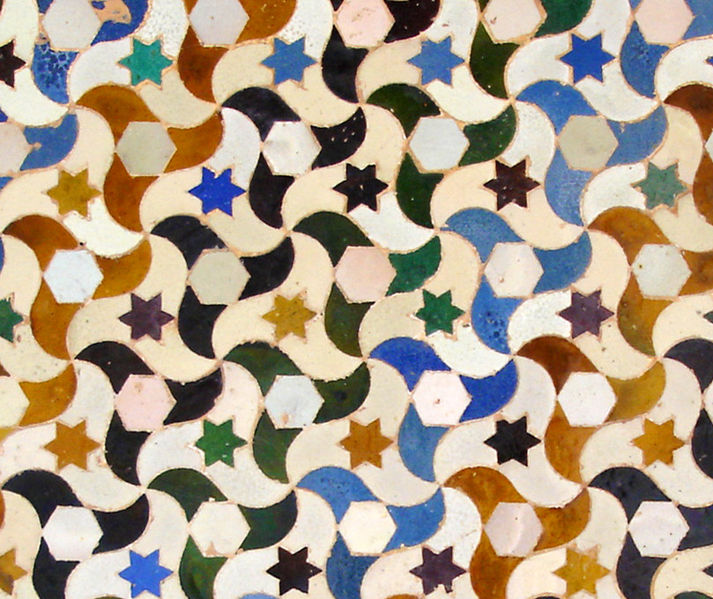
Tile from the Alhambra, Granada, Spain
Islam places creativity and art at the centre of human existence. Everything humans produce has an aesthetic quality, even the way we drive or speak. Art is the ability to generate beauty and we can all be artists in whatever we do, by doing it beautifully. This is ihsan. For example, our relationships need the quality of ihsan. Sound relationships are creative, and are based on the recognition of others’ souls. Human beings are the summit of creation, not to exploit others but to help the rest of creation to flourish. The Muslim as khalifa is a gardener, an artist, a carer of ophans. If we behave in these beautiful ways we will naturally embue our surroundings with beauty, just as the “classical mosques were built in the form of peoples’ souls” (1) as natural expressions of beauty rather than deliberate artistic creations.
Human beings have a special ability to distill and recycle beauty, meaning that we take the beauty of the natural world in through our senses, receive inspiration from the spirit (ruh), and then +add+ to the beauty of the natural world through our artistic creations. This cycle of creativity is the true source of sustainability.
Al-Ghazali said that “True art is in hearth and earth” (1). Abdal Hakim Murad (AHM) comments that ‘earth’ represents the natural realm and ‘hearth’ represents the human realm. The natural world, particularly its mineral and vegetal forms, provides inspiration for Muslim art. The human form is not a basis for Muslim art and AHM criticises Michelangelo as a “pagan restoration” – not monotheistic. AHM said there is something ‘theophanic’ about the human face which naturally draws our attention and changes the nature of a space, therefore human images are not suitable in a place of worship. However, even with regard to the mineral and vegetal, Muslims go beyond the outward forms and observe the underlying archetypes. In mosques we rarely see actual pictures of flowers or trees, but instead we see patterns of sacred geometry which abstract the underlying archetypes from the natural world and create serenity in our hearts.
(1) Abdal Hakim Murad, Al-Ghazali Retreat 2012
(2) ‘Contentions’, 17th set, number 2
Political Vacuum
In the ‘Nicomachean Ethics’ Aristotle writes: “If, then, there is some end of the things we do, which we desire for its own sake (everything else being desired for the sake of this), and if we do not choose everything for the sake of something else (for at that rate the process would go on to infinity, so that our desire would be empty and vain), clearly this must be the good and the chief good. Will not the knowledge of it, then, have a great influence on life? Shall we not, like archers who have a mark to aim at, be more likely to hit upon what is right? If so, we must try, in outline at least, to determine what it is, and of which of the sciences or capacities it is the object. It would seem to belong to the most authoritative art and that which is most truly the master art. And politics appears to be of this nature; for it is this that ordains which of the sciences should be studied in a state, and which each class of citizens should learn and up to what point they should learn them; and we see even the most highly esteemed of capacities to fall under this, e.g. strategy, economics, rhetoric; now, since politics uses the rest of the sciences, and since, again, it legislates as to what we are to do and what we are to abstain from, the end of this science must include those of the others, so that this end must be the good for man. For even if the end is the same for a single man and for a state, that of the state seems at all events something greater and more complete whether to attain or to preserve; though it is worth while to attain the end merely for one man, it is finer and more godlike to attain it for a nation or for city-states. These, then, are the ends at which our inquiry aims, since it is political science, in one sense of that term.”
Aristotle defines politics as the master art with the other arts and sciences its servants. Politics is responsible for prioritising the other arts and sciences and allocating resources to them. In recent years the political structures of the state have abdicated this role to ‘the market’. In effect, political power has been transferred to the market, meaning the banks and global financial institutions.
The financial markets allocate resources to the most financially lucrative trades, those with the highest rates of return. They prefer to pay no attention to the human or environmental effects of these trades. Our political system is the rule of money, where money chases ever more money with little regard for anything else, and all other ends are subservient to this. Money has incorrectly become an end in itself.
We need to replace this pathological system with an alternative politics which allocates resources where they will benefit people and the environment. To accomplish this we need alternative definitions of wealth, based around human well-being and the true value of the natural world.
Impractical Spirituality

The spirit is impractical. The spirit is of no use. It cannot be used. Any attempt to use the spirit contravenes its nature. Impractical spirituality is based on this recognition. Rather than try to use the spirit, impractical spirituality enjoys the beauty of spirit for its own sake.
To directly seek practical applications of the spirit such as ‘spirituality in the workplace’ is to miss the point. Sure, we can appreciate the beauty of the spirit anywhere: in the home, workplace, in the car, or on a plane — but attempts to put the spirit to use in those places are like trying to form water into a chair.
Better to let the spirit use us, because the spirit is not ours to command. In Arabic the path of the spirit (ruh) is called Ruhaniyat.
“They ask thee [Mohammed] concerning the spirit. Say: “the spirit comes by command of God. Only a little knowledge of it is given to you, (O men!)” Qur’an 17:85
Post-Modern Religion

Passage from modern to post-modern era according to Hiroki Azuma in "Génération Otaku - Les enfants de la postmodernité"
I would like to compare attitudes to religion across three periods of history: the traditional period, the modern period, and the post-modern period. Religions are generally associated with the traditional period, when they held sway, whereas the modern period is characterised by religion’s loss of dominance. It should be noted that different people, countries and areas of the world are at different points in the cycle: even within the same city it is possible to find modern and even post-modern people living in close proximity with traditional people.
Religion has survived in the modern period, although it has lost its dominance. Modern religion has different characteristics from traditional religion. A good place to find a systematic characterisation of modern religion is Donald Lopez’ book “A Modern Buddhist Bible” where he writes:
“Certainly, modern Buddhism shares many of the characteristics of other projects of modernity, including the identification of the present as a standpoint from which to reflect upon previous periods in history and to identify their deficiencies in relation to the present. Modern Buddhism rejects many of the ritual and magical elements of previous forms of Buddhism, it stresses equality over hierarchy, the universal over the local, and often exalts the individual over the community. (p.ix)”
Lopez also points out that modern Buddhism, like other modern expressions of religion, seeks to associate itself with the ideals of the European ‘Enlightenment’ such as “reason, empiricism, science, universalism, individualism, tolerance, freedom and the rejection of religious orthodoxy” (p.x).
Regarding the modern notion of progress which identifies “the present as a standpoint from which to reflect upon previous periods in history and to identify their deficiencies”, this is in sharp contrast to the traditional religious notion of degeneration (found in both Islam and Buddhism), which views the original teaching / revelation period (via the Prophet Mohammed and the Buddha respectively) as the ‘Golden Age’ and all subsequent generations as degenerating, more or less steeply, in virtues and accomplishments. Modernism is enamoured with the idea of progress and views the present as the most progressive age, looking down upon the ‘backwardness’ of previous ages, even the times of Mohammed and the Buddha.
The trick with modernism, as with all ideological prisms, is to recognise it as such from within. It appears so neutral, so objective, yet it is anything but. For example, the project of presenting Ibn Arabi’s philosophy to a ‘modern’ audience presupposes that such an audience even exists – in fact ‘modern’ times may be over, and the assumptions of modernism may be as (ir)relevant as the assumptions of Victorian Christianity.
Unlike modernism, post-modernism is not opposed to traditional religion. Post-modernism is basically looking for good stories (texts) and religions provide these (though it is worth noting that post-modernism prefers to relativise rather than accept any one story’s claim to absolute truth). The real strength of post-modernism comes from inhabiting the text: only by immersing oneself in the text and appreciating it from its own perspective can the story exert its full weight and narrative drive. Modernism, weighed down by its positivist agenda and burden of ‘objectivity’, can never cross the threshold of the religious text – it can only view it as a ‘spectacle’, like a tourist visiting Westminster Abbey. That is why modernists cannot truly appreciate religion.
Like traditionalists, post-modernists can and do step over the threshold of participation, and experience the force of the religious text. In this respect both are the “blind followers” so derided by modernists. The difference is that, unlike traditionalists, post-modernists retain a ‘knowing’ attitude (almost like Orwellian double-think) which enables them to simultaneous immerse themselves in and retain distance from the text.
Spiritual Constrictions

Based on the Taoist notion of Yin-Yang, I would like to introduce the idea of a ‘Yin’ constriction. (Please bear with me if you are already familiar with the basic concepts). Yin and Yang represent the two different aspects of the cosmos (similar to Jamal and Jalal in Islam). Yin and Yang have many different characteristics, which are all essentially relative, so I am not talking in absolutes here. In relation to each other, Yin is passive and Yang is active, Yin is yielding and Yang is penetrating, Yin is unstructured and Yang is structured, and Yin is soft and Yang is hard. As the popular Yin-Yang symbol suggests, cosmic balance is achieved when Yin and Yang are in balance with each other, and neither predominates overall.
Energy does not flow well if there is an unhealthy predominance of either Yin or Yang. In other words, an excess of either Yin or Yang is a constriction. A Yin constriction would occur if something is +too+ soft, +too+ unstructured, +too+ yielding. In spirituality (as with furniture) we require a combination of structure and unstructure, form and space, hardness and softness – otherwise we will end up falling on the floor. In this context the hardness means fixed points. Archimedes said “give me a fixed point and I can move the world”. If nothing is fixed them we have nothing to lever against to move through space, and we become immobile. In my opinion the ‘fixed points’ (principles) of religion should not just be criticised and dismissed as “precepts and dogma”, as then we will lose the opportunity to lever off them and gain spiritual momentum. This does not mean these principles have to be swallowed hook, line, and sinker: obviously an intelligent process of interpretation and jurisprudence is necessary.
Individual spiritual practitioners need different combinations of Yang and Yin, hard and soft, structure and unstructure, form and formlessness. A ‘one size fits all approach’ is not appropriate. The practitioners of the Yin side are just as capable of being dogmatic with their insistence on stripping away form as the Yang practitioners with their insistence on erecting it. Individuals should be free to choose the right balance for them.
Pushing religion at people is counter-productive – but so is pulling it away from them. Following the Buddhist example, it is important to develop equanimity (the middle way between attachment and aversion) to all phenomena including religion. The attitude of equanimity towards religion means understanding what it is, without prejudice, and making a conscious decision about how to relate to it. Certain modern, ‘spiritual’ schools express aversion to religion by focusing exclusively on the dangers of attachment to religion, ignoring the benefits of religion when practised appropriately.
Recipe for Spanish Omelette (Tortilla Española)

tortilla española
Ingredients:
- 1 large onion
- 3-4 medium potatoes. Waxy potatoes such as Maris Piper work best
- 5 large eggs
- 4 tablespoons olive oil
- sea salt

tortilla española
Equipment:
- Medium-large, non-stick frying pan with a lid (a plate will do)
- Medium-large mixing bowl
- Two warm plates
Method:
- Slice the onion and potatoes thinly.
- Fry the onions and potatoes for around 20 mins on a low heat in a covered frying pan in 3 tablespoons of olive oil. Stir occasionally.
- Season the potato and onion mixture well during cooking.
- Check the potatoes are soft – on the verge of breaking up.
- Break the eggs into a mixing bowl and gently beat. Season.
- Add the hot onion and potato mix to the eggs in the mixing bowl. Mix.
- Add the remaining 1 tablespoon of olive oil to the empty frying pan. Turn up the heat to medium.
- Pour the egg, potato and onion mixture into the pan. Turn the heat down to very low.
- Cook the mixture for about 15 minutes, until it is no longer runny on the top.
- Covering the frying pan with the lid or a plate, carefully turn the pan over, so that the omelette rests on the lid or plate. (I do this over the sink in case of an accident.)
- Put the frying pan back on the heat, and carefully return the omelette to the pan, with the cooked side now facing up.
- Cook the omelette for a further 6 minutes on a low heat until the other side is done.
- Tip out or invert the cooked omelette onto a clean, warm plate.
- Cover with a second warm plate to keep the omelette warm until ready to serve.
Enjoy with crusty bread!
The Concept of ‘Geist’
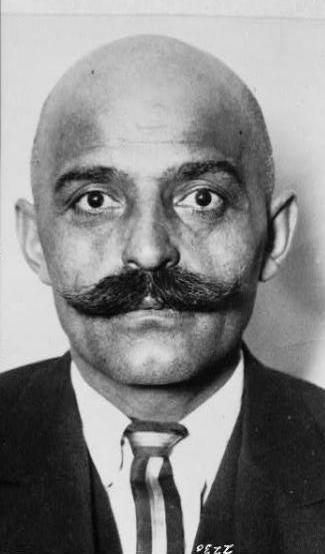
Gurdjieff
The concept I want to introduce is the Hegelian concept of ‘Geist’. When talking at a macro level about the rise and fall of civilisations or empires, the concept of Geist can be illuminating.
The point is that all national, religious and organisational success factors that can be identified by conventional study are secondary factors, the manifestations of Geist. The primary cause of success is Geist itself and the secondary factors are, in a sense, incidental. Even if an organisation possesses many of the factors that have made other organisations successful in the past, it will not be successful without Geist.
There is an analogy here with religious forms such as rituals, which are ‘left over’ by the movement of Geist. They may have been very useful at one time but, unless they continue to be infused by Geist, they become empty vessels.
How then can organisations deliberately tune into Geist? Leaving aside the moral questions for now, it is possible as Pierre Wack showed while working for Shell. His spiritual training with Gurdjieff allowed him to tune into macro scenarios like the coming Opec oil shock. But Geist (Arabic: Ruh) cannot be placed at man’s disposal – rather, we are at its disposal.
The Bloom On Fruits
Most men, even in this comparatively free country, through mere ignorance and mistake, are so occupied with the factitious cares and superfluously coarse labors of life that its finer fruits cannot be plucked by them. Their fingers, from excessive toil, are too clumsy and tremble too much for that. Actually, the laboring man has not leisure for a true integrity day by day; he cannot afford to sustain the manliest relations to men; his labor would be depreciated in the market. He has no time to be anything but a machine. How can he remember well his ignorance — which his growth requires — who has so often to use his knowledge? We should feed and clothe him gratuitously sometimes, and recruit him with our cordials, before we judge of him. The finest qualities of our nature, like the bloom on fruits, can be preserved only by the most delicate handling. Yet we do not treat ourselves nor one another thus tenderly. Some of you, we all know, are poor, find it hard to live, are sometimes, as it were, gasping for breath.
Henry Thoreau, ‘Walden’
Kashmiri Sufism and the Yogini Lal Ded

Yogini Lal Ded
The two founding figures of Kashmiri Sufism are Sheikh Nooruddin Noorani (1377 – 1440 CE) and Sheikh Ali Hamadani (1314 – 1384 CE). Both of them are said to have encountered a female Hindu yogini called Lal Ded (1320 – 1392 CE) who was in the habit of wandering around naked.
One story of Lal Ded mentions how she was teased by a number of children. A nearby cloth merchant scolded the children for their disrespect. Lal Ded asked the merchant for two lengths of cloth, equal in weight. That day as she walked around naked, she wore a piece of cloth over each shoulder and, whenever she was met with respect or scorn, she tied a knot in one or other cloth. In the evening, she brought the cloths back to the merchant, and asked him to weigh them again. Both cloths were equal in weight no matter how many knots were in each, showing that respect and scorn have no weight of their own.
It is said that, when Sheikh Nooruddin Noorani was born, initially he wouldn’t feed from his mother. After 3 days, Lal Ded arrived and suckled him herself. She said to the baby that, since he hadn’t been ashamed to be born, why should he be ashamed to drink from his mother’s breast?
According to another story, when Lal Ded encountered Sheikh Ali Hamadani she jumped into a tandoor (clay oven) and, when the Sheikh lifted the lid, Lal Ded came out dressed in flowers. When she was asked why she was dressed for the first time she replied saying “Today I saw a man for the first time”.
These stories are related to the differing attitudes of Kashmiris to the two Sheikhs: Sheikh Nooruddin is revered by both Hindu and Muslim Kashmiris alike as a harmonizing force, the embodiment of Kashmiriyat. Sheikh Hamadani, revered by Kashmiri Muslims as a saint and true man (Insan Kamil), is resented by some Hindus as a Muslim supremacist.
The Kashmiri Sufi poet Shams Faqir paid tribute to Lal Ded (Lalla) in the following poem:
O you enlightened one,
Recognize the vital air and attain gnosis
To realize God:
Real worship is performed
In life’s workshop itself:
What the holy scriptures truly mean
By “the house of idols”;
Lalla achieved the fusion
Of her vital air and ether,
And thus realized God;
Sodabhai (on the other hand) got lachrymose,
What would he ask of the stone image?
Lalla dropped the pitcher of water
Inside the house of idols
And attained god-realization:
Intoxicated (as a mystic) she contrived
To bathe at the confluence of ‘sixteen rivers’,
And she built a ‘bridge’
Across the ocean of temporal existence;
She knocked off the Devil’s head
And gained self-recognition;
The ‘unskilled carpenter’,
Having built the palace in wilderness,
Learnt a lesson from Lalla!
She had to bear with the stone
Her mother-in-law kept concealed
In the plate of rice served to her
(She stood to gain from this austerity);
Lalla went to Nunda Rishi’s to teach him her doctrine –
What the rinda mystics call gnosis (irfaan);
She played ‘hide and seek’ with Shah Hamdan
And had a direct ‘encounter’ with God;
O, you learned Shams,
The sun does not have a shadow;
Lalla ascended to heaven like a cloud,
Realize God (as she did).
quoted from:
Lal Ded: The Great Kashmiri Saint-Poetess
Edited by: Dr. S. S. Toshkhani
Proceedings of the National Seminar
Conducted by Kashmir Education, Culture and Science Society,
B-36, Pamposh Enclave, New Delhi – 110 048
November 12, 2000
 Politics of Soul